
manual hoists
Manual Hoists: A Comprehensive Guide
Manual hoists, utilizing chain drives for efficiency, are vital lifting tools across industries, offering a safe and simple solution for material transport and incline movement.
Manual hoists represent a cornerstone of lifting technology, offering a reliable and cost-effective solution for a diverse range of applications. Unlike their powered counterparts, these devices rely on human mechanical advantage, eliminating the need for electricity and making them ideal for remote locations or environments where power sources are unavailable.
Their simplicity belies a robust engineering foundation, rooted in decades of evolution – from early rudimentary designs to the sophisticated systems available today. These hoists are frequently employed in construction, manufacturing, and maintenance, facilitating the safe and efficient movement of materials. Understanding their principles, types, and safety protocols is crucial for anyone involved in lifting operations, ensuring both operational efficiency and personnel safety.
What is a Manual Hoist?
A manual hoist is a mechanical lifting device operated by hand power, utilizing a ratchet mechanism and often a chain drive to raise or lower loads. These devices, including chain blocks and lever hoists, provide a mechanical advantage, allowing users to lift weights significantly exceeding their own strength;
Essentially, a manual hoist transforms pulling force into lifting power. The BANK HOIST type exemplifies this, transporting materials up inclines without relying on electricity. They are characterized by their portability, ease of use, and relatively low maintenance requirements. Crucially, understanding the rated capacity and adhering to safety standards are paramount when operating these tools, ensuring secure lifting and preventing accidents.
History and Evolution of Manual Hoists
The origins of manual hoists trace back to ancient civilizations employing basic pulley systems for lifting. Over centuries, these evolved, incorporating advancements in materials and mechanical principles. The development of chain drives, specifically steel roller chains adhering to standards like ISO 487:1998, was a pivotal moment.

Early iterations were largely reliant on muscle power, but the introduction of ratchet mechanisms and gear systems significantly increased efficiency and control. Modern manual hoists benefit from improved manufacturing techniques and a focus on safety features. Today, they remain essential tools, despite the rise of electric alternatives, valued for their reliability, portability, and ability to operate without external power sources.

Types of Manual Hoists
Various manual hoist types exist, including chain, lever, wire rope, and gear-driven models, each designed for specific lifting tasks and load capacities.
Chain Hoists: Design and Applications
Chain hoists are a prevalent type, distinguished by their robust construction and reliance on chain mechanisms for lifting operations. These hoists utilize a handwheel and gear system to manipulate the load chain, providing controlled lifting and lowering. They are commonly built adhering to standards like ISO 487:1998, ensuring chain quality and specifications are met.
Their applications are widespread, spanning construction sites for material handling, manufacturing facilities for moving components, and warehouses for efficient loading and unloading. The design allows for vertical lifting, making them ideal for confined spaces. Steel roller chains, with attachments and sprockets, contribute to their reliable performance. Chain hoists offer a balance of strength, durability, and relatively low maintenance, making them a versatile choice for numerous lifting needs.
Lever Hoists: Advantages and Limitations
Lever hoists, often referred to as chain blocks, provide a significant mechanical advantage, enabling users to lift heavy loads with minimal effort. Their compact design and portability make them suitable for various applications where space is limited or frequent relocation is required. They are frequently used in automotive repair, marine settings, and for general maintenance tasks.
However, lever hoists have limitations. While efficient for lifting, they typically have a slower lifting speed compared to other hoist types; The lifting capacity is also generally lower than that of wire rope hoists. Careful consideration of the rated capacity and adherence to safety standards are crucial to prevent overloading and ensure safe operation. Regular inspection of the chain and latch mechanisms is essential for maintaining functionality.
Wire Rope Hoists: Heavy-Duty Lifting Solutions
Wire rope hoists are engineered for demanding lifting applications, excelling in scenarios requiring substantial capacity and durability. These hoists utilize strong wire ropes and robust construction to handle exceptionally heavy loads, making them ideal for construction sites, manufacturing facilities, and marine environments where large components or materials need to be moved.
Despite their strength, wire rope hoists necessitate careful operation and maintenance. Regular inspection of the wire rope for wear, fraying, or corrosion is paramount. Proper lubrication is vital to ensure smooth operation and extend the hoist’s lifespan. Adhering to strict load limits and avoiding side loading are crucial safety precautions when utilizing these heavy-duty lifting solutions.
Gear-Driven Hoists: Precision and Control
Gear-driven hoists offer a unique advantage: exceptional precision and control during lifting operations. Utilizing a sophisticated gear system, these hoists allow for incremental adjustments and smooth, controlled movements, making them suitable for tasks demanding accuracy. This level of control is particularly valuable in manufacturing, automotive repair, and situations where delicate positioning is essential.
The gear system also contributes to increased mechanical advantage, reducing the operator’s effort required to lift heavy loads. Regular maintenance, including lubrication of the gears, is crucial for optimal performance and longevity. Careful inspection of the gear teeth for wear or damage ensures continued safe and precise operation.

Key Components of a Manual Hoist
Essential components include the hoist chain, load chain, hooks with latches, and a handwheel connected to a gear system – all ensuring secure and reliable lifting.
Hoist Chain and its Specifications
The hoist chain is a critical element, directly impacting the safety and performance of the manual hoist. Specifications, often adhering to ISO 487:1998 standards for steel roller chains, define its strength, durability, and suitability for specific load capacities. These chains, available in various types (S and C), are meticulously engineered to withstand significant tensile forces.
Chain selection considers factors like the working load limit, chain pitch, and material composition. Regular inspection is paramount; damage, wear, or elongation compromises the chain’s integrity. Proper lubrication minimizes friction and extends its lifespan. Understanding these specifications ensures optimal operation and prevents catastrophic failures during lifting operations, safeguarding personnel and materials.
Load Chain and its Importance
The load chain, intrinsically linked to hoist chain specifications like ISO 487:1998, is the direct pathway for transferring lifting force. Its importance cannot be overstated; it’s the component bearing the entire weight of the suspended load. Constructed from high-strength steel, the chain must resist stretching, breaking, and corrosion to maintain operational safety.
Regular inspection for wear, kinks, or damage is crucial. Elongation indicates stress and potential failure. Proper lubrication reduces friction, extending chain life and ensuring smooth operation. Selecting the correct load chain, matched to the hoist’s capacity, is vital. A compromised load chain directly jeopardizes lifting integrity, potentially leading to dropped loads and severe consequences.
Hooks and Latches: Ensuring Secure Lifting
Hooks and latches are critical connection points in any manual hoist system, directly impacting load security. These components must withstand significant tensile forces and prevent accidental disengagement. Hooks should be forged, not cast, to avoid brittle fracture, and regularly inspected for cracks, deformation, or wear. A damaged hook compromises the entire lifting operation.
Latches, often spring-loaded, provide an additional layer of security, preventing the load from slipping off the hook. Proper latch function is paramount; a faulty latch renders the hook ineffective. Regular maintenance, including cleaning and lubrication, ensures smooth operation. Always verify the latch is fully closed and secure before lifting any load, adhering to safety protocols.
Handwheel and Gear System: Operation and Maintenance
The handwheel and gear system translate manual effort into lifting power. Rotating the handwheel engages the gears, which in turn move the hoist chain, raising or lowering the load. Smooth, consistent operation indicates a well-maintained system. Regular lubrication is essential, preventing friction and ensuring efficient power transfer. Use the manufacturer’s recommended lubricant for optimal performance.
Inspect gears for wear, chipped teeth, or misalignment. A damaged gear system reduces lifting capacity and increases the risk of failure. Proper maintenance extends the lifespan of the hoist and guarantees safe operation. Avoid forcing the handwheel; resistance suggests a problem requiring immediate attention and potential repair.

Working Principles of Manual Hoists
Manual hoists leverage mechanical advantage and ratchet mechanisms, utilizing braking systems for controlled lifting and secure load positioning, ensuring operational safety.
Mechanical Advantage Explained
Mechanical advantage in manual hoists is the ratio of output force (lifting the load) to the input force (effort applied to the handwheel or lever). This principle dramatically reduces the force a user needs to exert to lift heavy objects; Hoists achieve this through clever design, employing gear systems or chain configurations.
Essentially, the hoist multiplies the applied force. A higher mechanical advantage means less effort is required, but it also typically translates to slower lifting speeds. The design of the hoist, specifically the gear ratio or the number of chain parts supporting the load, dictates this advantage. Understanding this concept is crucial for safely and efficiently operating a manual hoist, maximizing its lifting capacity while minimizing operator fatigue.
Ratchet Mechanism and its Role
The ratchet mechanism is a fundamental safety feature within manual hoists, preventing loads from unintentionally descending. It functions by allowing the hoist chain to be pulled in one direction, lifting the load, but resisting movement in the opposite direction. This ‘pawl and ratchet’ system engages automatically with each pull, securely locking the chain in place.
This crucial component ensures that the lifted load remains stable, even if the operator releases the lifting force. Regular inspection of the ratchet mechanism is vital; wear or damage can compromise its functionality, creating a significant safety hazard. A properly functioning ratchet is paramount for controlled lifting and lowering operations, guaranteeing operator and bystander safety.
Braking Systems: Safety Features
Braking systems in manual hoists are critical safety features designed to supplement the ratchet mechanism, providing an additional layer of protection against accidental load drops. These systems typically employ friction-based brakes that engage when lifting force is released, firmly holding the load in position.
Effective braking ensures controlled descent, even with unevenly distributed weight or during sudden stops. Regular maintenance, including inspection and adjustment of brake linings, is essential for optimal performance. A compromised braking system significantly increases the risk of accidents, highlighting the importance of diligent upkeep and adherence to safety protocols during hoist operation and routine checks.

Safety Considerations When Using Manual Hoists
Prioritize safety by understanding rated capacity, performing pre-use inspections, employing proper slinging techniques, and avoiding both overloading and side loading scenarios.
Rated Capacity and Load Limits
Understanding the rated capacity of a manual hoist is paramount for safe operation. This specification, often defined in accordance with standards like ISO 487:1998, represents the maximum load the hoist can lift without risk of failure. Exceeding this limit – known as overloading – compromises the hoist’s structural integrity and poses a significant safety hazard.
Load limits are clearly marked on the hoist itself and must be strictly adhered to. Operators should always verify the weight of the load before lifting, utilizing appropriate weighing equipment if necessary. Furthermore, consider not only the weight of the primary load but also the weight of any slings, shackles, or other lifting accessories used in conjunction with the hoist. Ignoring these factors can easily push the total weight beyond the hoist’s safe working load.
Inspection Procedures Before Each Use
Prior to every use, a thorough inspection of the manual hoist is crucial for identifying potential hazards. Begin by examining the hoist chain and load chain for wear, damage, or distortion. Look for stretched, cracked, or corroded links. Inspect hooks and latches, ensuring they are securely fastened and free from deformation.
Verify the proper operation of the braking system and ratchet mechanism. Confirm the handwheel rotates smoothly and engages correctly. Any irregularities, such as slipping or excessive resistance, should be addressed immediately. A detailed review, referencing the original installation and operation manual, is vital. Remember, proactive inspection prevents accidents and extends the hoist’s lifespan.
Proper Slinging Techniques
Correct sling application is paramount for safe lifting with manual hoists; Always select slings appropriate for the load’s weight, shape, and lifting environment. Ensure the sling’s rated capacity exceeds the load’s weight, factoring in any dynamic forces. Employ proper hitch types – vertical, choker, or bridle – based on the load’s characteristics and sling capabilities.
Inspect slings before each use for cuts, abrasions, or other damage. Avoid sharp bends or kinks that can weaken the sling. Center the load within the sling’s cradle to distribute weight evenly and prevent instability. Never drag or pull slings across abrasive surfaces. Securely attach slings to the load and hoist hook, verifying proper engagement before lifting.
Avoiding Overloading and Side Loading
Overloading a manual hoist compromises its structural integrity and poses a significant safety risk. Always adhere to the hoist’s rated capacity, clearly marked on the unit. Never exceed this limit, even for seemingly minor lifts. Side loading, applying force off-center from the hook, is equally dangerous, potentially bending or breaking components.
Ensure the load is balanced and directly below the hoist hook before lifting. Avoid using slings that create angled pulls, as this introduces side loading. Smooth, controlled lifting and lowering motions minimize stress on the hoist. Regular inspections can identify signs of stress or damage caused by improper loading practices, preventing potential failures.
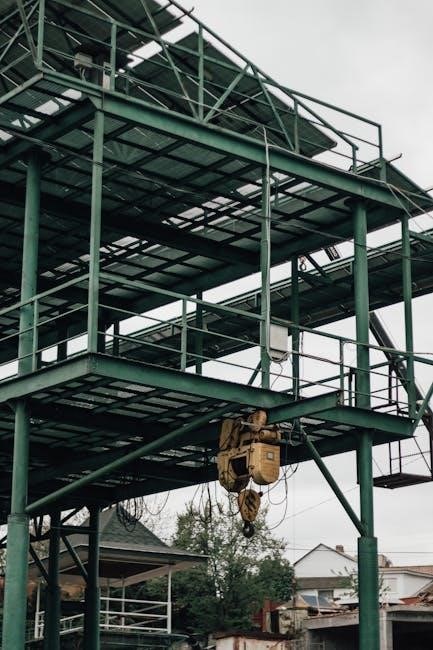
Applications of Manual Hoists
Manual hoists find diverse applications in construction, manufacturing, automotive repair, and marine settings, efficiently transporting materials and equipment with reliable precision.
Construction Industry Uses
Manual hoists are indispensable on construction sites, providing controlled lifting solutions for a variety of materials. They excel in scenarios where powered equipment is impractical or unavailable, offering a safe alternative for moving tools, equipment, and building components. Their portability allows for flexible use across different work areas, adapting to the dynamic nature of construction projects.
Specifically, they aid in lifting materials to elevated platforms, assisting with formwork installation, and facilitating the precise positioning of heavy objects. The reliance on manual power ensures operation even without electricity, a crucial benefit in remote locations or during power outages. Prioritizing safety, proper inspection and adherence to load limits are paramount when utilizing manual hoists within the demanding construction environment.
Manufacturing and Warehouse Applications
Manual hoists prove exceptionally valuable within manufacturing and warehouse settings, streamlining material handling processes. Their compact design and ease of operation make them ideal for tasks involving repetitive lifting and positioning of goods, components, and finished products. They are particularly useful in areas with limited space, where larger lifting equipment may be cumbersome.
Applications range from lifting raw materials onto production lines to moving completed items for storage or shipping. The inherent safety features, like ratchet mechanisms and braking systems, contribute to a secure working environment. Regular lubrication and chain inspection, as outlined in maintenance guidelines, are crucial for sustained performance and preventing operational disruptions within these fast-paced facilities.
Automotive Repair and Maintenance
Manual hoists are indispensable tools in automotive repair shops, providing controlled lifting for engine removal, transmission servicing, and suspension work. Their precision and control, offered by gear-driven systems, are crucial when dealing with heavy and sensitive components. The ability to precisely position loads minimizes the risk of damage during intricate repairs.
Furthermore, manual hoists excel in situations where electrical power is unavailable or impractical. Adhering to rated capacity limits and performing pre-use inspections are paramount for safety. Proper slinging techniques, utilizing appropriate hooks and latches, ensure secure lifting and prevent accidental drops, safeguarding both personnel and vehicle integrity within the repair bay.
Marine and Boat Lifting
Manual hoists play a critical role in marine environments, facilitating the lifting and maneuvering of smaller boats, outboard motors, and other heavy equipment. Their robust construction and reliable braking systems are essential when working near water, where corrosion and safety are paramount concerns. The compact structure of lever hoists proves particularly useful in confined spaces aboard vessels or within boatyards.
Regular lubrication and chain inspection are vital to maintain operational integrity in the harsh marine climate. Strict adherence to load limits, as defined by ISO 487:1998 chain specifications, prevents overloading and ensures safe lifting operations. Careful consideration of slinging techniques is also crucial to protect boat hulls from damage during lifting procedures;

Maintenance and Troubleshooting
Regular lubrication, chain inspection, and prompt attention to common issues—like slipping or jamming—are key to ensuring the longevity and safe operation of manual hoists.

Regular Lubrication Practices
Consistent lubrication is paramount for maintaining the smooth operation and extending the lifespan of a manual hoist. Focus lubrication efforts on key components, including the load chain, gears, and any pivot points. Utilize a high-quality lubricant specifically designed for heavy-duty lifting equipment; avoid using general-purpose oils, as they may not provide adequate protection.
Apply lubricant after each shift or, at minimum, weekly, depending on usage frequency. Thoroughly clean components before lubrication to remove dirt and debris. Pay close attention to the chain, ensuring complete coverage for optimal performance and reduced wear. Proper lubrication minimizes friction, prevents corrosion, and contributes significantly to overall hoist safety and reliability. Neglecting this practice can lead to costly repairs and potential hazards.
Chain Inspection and Replacement
Regular chain inspection is critical for safe manual hoist operation, adhering to standards like ISO 487:1998 for chain specifications. Examine the chain for wear, damage, corrosion, and deformation. Look for stretched links, cracked or broken strands, and any signs of pitting. Carefully inspect the chain after each use, and conduct a more thorough inspection monthly.
If any defects are identified, immediately remove the hoist from service. Replace the entire chain, not just individual links, as localized damage often indicates widespread wear. Use only manufacturer-approved replacement chains, ensuring compatibility with the hoist’s rated capacity. Document all inspections and replacements for traceability and safety compliance. A compromised chain poses a significant lifting hazard.
Common Issues and Solutions
Manual hoists can experience several issues. A slipping brake often indicates contamination or wear within the braking system; cleaning or replacement is needed. Difficulty in lifting may stem from insufficient lubrication of gears or a damaged gear system, requiring cleaning and greasing or component replacement. Stiff operation suggests a lack of lubrication or internal binding.
Chain jamming can occur due to improper spooling or debris; carefully re-spool the chain and remove obstructions. If the hoist fails to hold a load, suspect a ratchet mechanism failure – immediate inspection and repair are crucial. Always prioritize safety; if a problem persists, consult a qualified technician. Regular maintenance minimizes these issues.
Storage and Handling Guidelines
Proper storage is crucial for maintaining manual hoist functionality. Always store hoists in a clean, dry environment to prevent rust and corrosion. Avoid exposure to extreme temperatures or humidity. When not in use, fully retract the chain and secure it to prevent damage or entanglement.
During handling, avoid dropping or impacting the hoist, as this can compromise internal components. Never lift the hoist by its load chain or hook; use designated lifting points. Inspect the hoist for damage before each storage period and after any handling. Following these guidelines ensures longevity and safe operation.

Standards and Regulations
Compliance with ISO 487:1998, specifying steel roller chain standards, and relevant safety regulations is paramount for manual hoist operation and certification.
ISO 487:1998 — Chain Specifications
ISO 487:1998 provides detailed specifications for steel roller chains, crucial components within many manual hoist systems. This standard covers chains of types S and C, alongside associated attachments and sprockets, ensuring interchangeability and consistent quality. It meticulously defines dimensions, material properties, and mechanical characteristics, impacting the hoist’s load capacity and operational lifespan.
Adherence to ISO 487:1998 guarantees that the chain meets rigorous performance criteria, minimizing the risk of failure during lifting operations. The standard addresses factors like tensile strength, fatigue resistance, and wear properties, directly influencing safety and reliability. Manufacturers utilizing this standard demonstrate a commitment to producing durable and dependable hoist chains, vital for various industrial applications. Proper chain selection, based on ISO 487:1998 guidelines, is essential for safe and efficient manual hoisting.
Relevant Safety Standards
Safety standards are paramount when operating manual hoists, mitigating risks associated with lifting operations. Beyond ISO 487:1998 for chain specifications, broader regulations govern hoist design, use, and maintenance. These standards emphasize the importance of rated capacity adherence, preventing overloading and potential failures.
Manufacturers and users must comply with guidelines concerning inspection procedures, ensuring components are free from defects before each use. Proper slinging techniques, detailed in safety manuals, are crucial for secure load handling. Furthermore, awareness of potential hazards like side loading and the need for regular maintenance are key. Compliance and certification demonstrate a commitment to worker safety and responsible lifting practices, minimizing accidents and ensuring operational integrity.
Compliance and Certification
Demonstrating compliance with relevant safety standards, like ISO 487:1998, is crucial for manual hoist operation. Certification assures users that the hoist meets defined performance and safety criteria. This often involves rigorous testing and inspection by accredited bodies, verifying adherence to design specifications and operational guidelines.
Manufacturers typically provide documentation confirming compliance, while users should maintain records of inspections and maintenance. Certification isn’t merely a formality; it signifies a commitment to worker safety and responsible lifting practices. Adhering to these standards minimizes risks, reduces liability, and ensures the hoist operates reliably. Proper documentation and adherence to regulations are essential for a safe and compliant lifting environment.
Leave a Reply
You must be logged in to post a comment.